
Procurement reviews
The Tribunal is responsible for safeguarding the integrity of the Government of Canada’s procurement processes.
The Tribunal:
- inquires into complaints by potential suppliers of goods or services to the federal government relating to designated contracts valued above prescribed monetary thresholds;
- determines whether procurement processes under complaint complied with Canada’s obligations under certain trade agreements;
- considers issues such as whether bids were evaluated fairly;
- recommends remedies and award costs; and
- provides recommendations to federal government institutions about their procurement processes.
There are potentially up to three stages in the consideration by the Tribunal of any procurement complaint:
- Acceptance stage – Within five working days of receipt of a properly documented complaint, the Tribunal determines whether the complaint is filed within statutory deadlines, whether it concerns a procurement process subject to the Tribunal’s jurisdiction, and whether the complaint discloses a reasonable indication of breach of compliance with the trade agreements. If those conditions are met, the Tribunal begins an inquiry.
- Inquiry stage – Inquiries are completed within 45, 90, or 135 days, depending on the complexity of a matter. The Tribunal examines the complainant’s allegations, the submissions of the government institution involved in the matter, and in certain cases submissions by interested parties who have joined the proceedings as intervenors. Typically, submissions are made in writing, but oral hearings are convened in certain instances. If a complaint is valid, the Tribunal will recommend an appropriate remedy, as such as that new solicitation be issued, that bids be re-evaluated, that the contract be terminated, that it be awarded to the complainant or that the complainant be compensated by an amount specified by the Tribunal.
- Compensation stage – If a complaint is valid and the Tribunal recommends compensation (i.e. a monetary award), the Tribunal typically asks parties to negotiate a mutually agreed amount of compensation. If parties cannot agree on an amount, the Tribunal will receive submissions and decide on an appropriate amount of monetary compensation.
Overview of the procurement complaint process
- A potential supplier is informed by the government institution that they are not the successful bidder.
- The potential supplier has 10 working days to file a complaint with the Tribunal.
- The Tribunal reviews the complaint to determine whether it can be accepted for inquiry. The potential supplier (now complainant) is notified within one week if the complaint is accepted for inquiry.
- If the complaint is accepted for inquiry, in one month the complainant receives a copy of the Government Institution Report, which is the government institution’s response to the complaint. The complainant has 7 working days to provide comments on the report.
- In most cases, within 90 calendar days from its receipt, the Tribunal determines whether the complaint is valid, valid in part or not valid.
If the complainant disagrees with the Tribunal’s findings, they can ask the Federal Court of Appeal to review the matter.
Relationship between the Tribunal and the Office of the Procurement Ombudsman
Since October 1, 2020, the Office of the Procurement Ombudsman (OPO) and the Tribunal have implemented a Memorandum of Understanding (MOU). The MOU aims at facilitating suppliers’ access to the complaint review mechanisms administered by both organizations. It also provides for continued cooperation between OPO and the Tribunal. The Tribunal and OPO have concurrent jurisdiction over procurement complaints brought by Canadian suppliers as follows:
| Canadian International Trade Tribunal | Office of the Procurement Ombudsman |
|---|---|
| Goods valued at $30,300 and above | Goods valued under $30,300 |
| Services valued at $121,200 and above | Services valued under $121,200 |
The Tribunal has exclusive jurisdiction over complaints by foreign suppliers about designated federal government procurement processes under applicable trade agreements. When filing a complaint with either OPO or the Tribunal, complainants are given the option to share their contact information and the basic nature of their complaint with the other organization. This exchange mechanism enhances access to justice by ensuring that complainants are filing their grievances in the right place and, most importantly, in the timeliest manner possible. During this fiscal year, 54 complainants were assisted in this manner.
Officials from OPO and the Tribunal and its secretariat meet regularly to monitor implementation of the MOU.
Historical trend: procurement complaints received
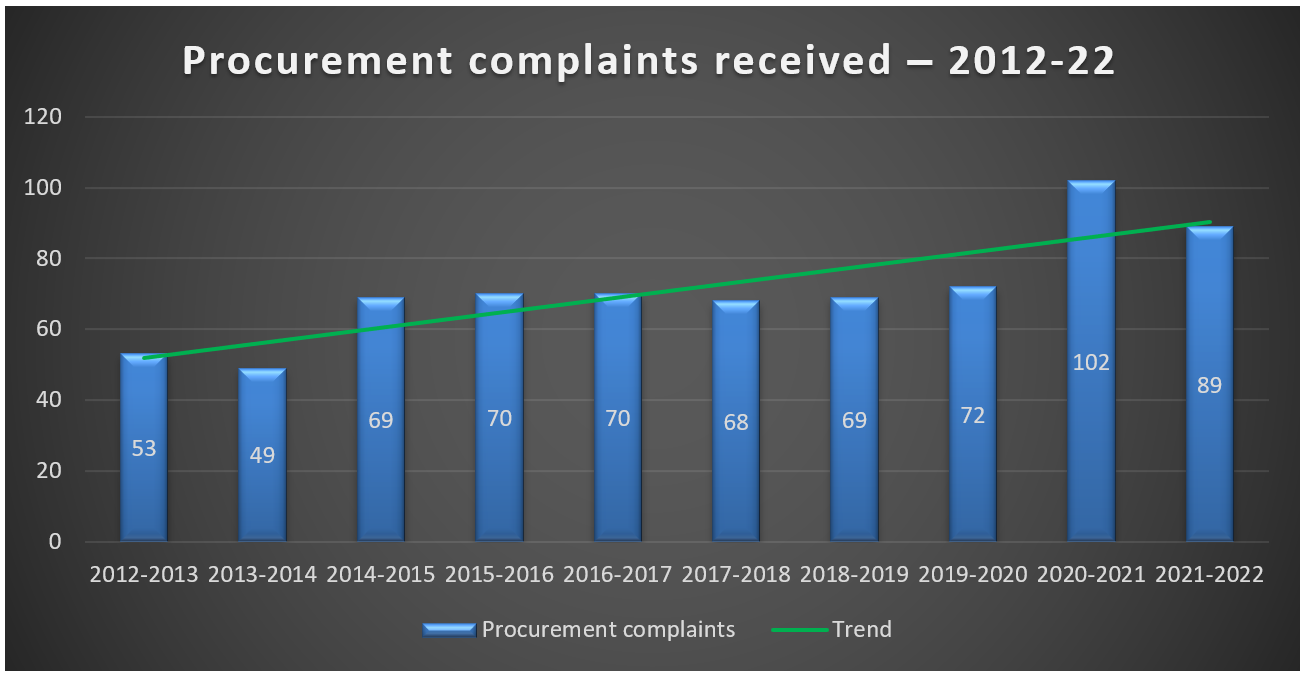
The Tribunal’s caseload for its procurement review mandate remains high. As indicated in the following table, the number of complaints received by the Tribunal in 2021-22 was 36 percent higher than in 2012-13, with the average number of complaints received during a five-year period having increased from 62 during the 2012-17 period to 79 during the 2017-22 period. This represents an increase of 27.4 percent between periods.
Procurement review activities in 2021-22
| Carried over from previous fiscal year | 21 |
|---|---|
| Received during this fiscal year | 89 |
| Total | 110 |
| Disposed during this fiscal year | 101 |
| Remaining outstanding at the end of fiscal year | 9 |
| Total decisions issued | 55 |
|---|---|
|
Of which: |
|
|
Lack of jurisdiction/not a potential supplier |
3 |
|
Late filing |
7 |
|
Not a designated contract/no reasonable indication of a breach/premature |
45 |
| Withdrawn/abandoned | 5 |
| Still ongoing at the end of fiscal year | 4 |
| Total decisions issued | 41 |
|---|---|
|
Of which: |
|
|
Dismissed/Ceased |
13 |
|
Not valid (includes 2 remanded complaints) |
20 |
|
Valid or valid in part |
8 |
| Still ongoing at the end of fiscal year | 5 |
Compensation
Two compensation orders were issued during this fiscal year: Marine International Dragage (M.I.D.) Inc. v. Department of Public Works and Government Services (PR-2020-023) and Inventa Sales & Promotions v. Department of Public Works and Government Services (PR-2021-009).
| Carried over from previous fiscal year | 3 |
|---|---|
| Initiated during this fiscal year | 2 |
| Total | 5 |
| Disposed during this fiscal year | 2 |
| Remaining ongoing at the end of fiscal year | 3 |
Sample of noteworthy decisions under the procurement review mandate
The cases highlighted this year concern systemic challenges faced by suppliers. They relate to governance and procedural issues, namely:
- transparency of the procurement processes;
- bid delivery;
- set-aside procurement strategies for Indigenous suppliers; and
- national security exceptions.
Bronson Consulting Group Inc. (PR-2020-071)
This complaint concerned a Request for Abbreviated Proposals issued by Defence Construction Canada (DCC) on behalf of the Department of National Defence for historical records research and document management production services. Bronson Consulting Group Inc. (Bronson) alleged that DCC inappropriately deducted points in its technical evaluation. Bronson sought to have the awarded contract cancelled, its proposal re-evaluated, and the contract awarded to the highest scoring proponent. The Tribunal found that the grounds of complaint raised by Bronson were not valid and that DCC’s overall technical evaluation was reasonable.
In these proceedings, DCC refused to disclose certain information that should normally have been disclosed under the Canadian International Trade Tribunal Rules. DCC took the position that section 30 of the Defence Production Act (DPA) prevented it from disclosing such information. DCC had previously participated in several other proceedings at the Tribunal without having raised similar opposition. The Tribunal did not order DCC to disclose the information. However, the Tribunal ruled that it would have drawn negative inferences from such a refusal to disclose if the information in question had been necessary to resolve the complaint. The Tribunal also contemplated that an improper refusal to disclose information could constitute a breach of the trade agreements. The Tribunal warned that section 30 of the DPA should not become a vehicle for DCC to avoid its disclosure obligations in procurement complaints to which it is a party.
Aqua Valley Water (PR-2020-098)
This complaint concerned a notice of proposed procurement issued by the Department of Public Works and Government Services (PWGSC) on behalf of the Department of National Defence for the supply of bottled water. Aqua Valley Water (Aqua Valley) was the incumbent on the previous contract, which had been extended several times. Aqua Valley was expecting a new solicitation to be issued but was asked to extend its deliveries on the basis that a new solicitation had been delayed because of the COVID-19 pandemic. A new solicitation was issued, but Aqua Valley did not notice it, and the bid closing deadline passed unbeknownst to it. It then learned that a new contract had been awarded to a competitor. Aqua Valley alleged that PWGSC had misled it into believing that a new solicitation would be suspended until the COVID-19 pandemic was over. The Tribunal held that the complaint was valid.
The Tribunal found that PWGSC’s actions or inactions effectively deprived Aqua Valley of being able to submit a bid. The Tribunal found that the procurement process for the new solicitation was proceeding concurrently with the ongoing performance and management of the prior contract, and that there was a lack of openness and transparency by PWGSC. The Tribunal paralleled the duty of honest performance described in the Supreme Court of Canada’s decision in C.M. Callow Inc. v. Zollinger with trade agreement requirements pertaining to the conduct of fair, open and transparent procurement processes. The Tribunal noted that heightened sensitivity to communications was never more important than during the unique circumstances created by the pandemic.
Rampart International Corporation (PR-2021-023 and PR-2021-028)
These complaints concerned a request for proposal (RFP) issued by PWGSC on behalf of the Department of National Defence for a replacement pistol and holster system for the Canadian Armed Forces. The prime allegation in this matter was that some of the RFP’s technical specifications and requirements breached the provisions of the Canadian Free Trade Agreement (CFTA), as they favoured a specific pistol design produced by only two manufacturers, namely SIG Sauer and Beretta. As such, it was alleged that the RFP’s mandatory criteria unreasonably excluded some pistols, including the Glock pistols that Rampart International Corporation intended to bid. The Tribunal held that the complaints were valid and recommended the cancellation and the re-issuance of the solicitation.
The Tribunal found that the method by which the specifications were established was contrary to the requirement of Article 500 of the CFTA to “to establish a transparent and efficient framework to ensure fair and open access to government procurement opportunities for all Canadian suppliers.” The Tribunal found that PWGSC breached Article 509(3) by not allowing bidders to propose equivalents to specifications that required a particular design or type. Failure to do so in this instance was fatal to the integrity of this procurement process. The Tribunal encouraged PWGSC to use performance or functional requirements when retendering because they are more easily relatable to legitimate operational requirements.
Asokan Business Interiors (PR-2021-045)
This complaint concerned a request for bid (RFB) issued by the Department of Finance for the provision of office chairs. Asokan Business Interiors alleged that the Department of Finance improperly declared its bid non-compliant with a mandatory criterion of the RFB. The Tribunal ceased its inquiry into the complaint because the complaint was subsequently withdrawn and because the RFB was subject to a trade agreement set-aside for Aboriginal businesses. A trade agreement set aside for Aboriginal businesses deprives the Tribunal from any power to inquire into a complaint concerning procurements under initiatives such as the Procurement Strategy for Aboriginal Business.
The Tribunal expressed concerns in its determination regarding the fact that Indigenous suppliers currently have fewer rights of access to justice than non-indigenous Canadians and even certain foreign suppliers. Indeed, indigenous persons and businesses who participate in government procurement opportunities currently do not have access to the Tribunal’s bid challenge mechanism and can only turn to courts to seek formal redress whenever an Aboriginal set-aside is invoked.
University of Guelph, Laboratory Services Division (PR-2021-047) and Thales Canada Inc. (PR-2021-067)
The noteworthy character of these two complaints stems from the fact that each complainant faced a very similar substantive issue (namely challenges in the use of the Canada Post’s epost Connect system) in their respective procurement processes but ended up having very different access to the recourse mechanism provided by the Tribunal. In short, the University of Guelph, Laboratory Services Division (University of Guelph) was able to have its complaint investigated, whereas Thales Canada Inc. (Thales) was not.
The complaint by the University of Guelph concerned an RFP issued by PWGSC on behalf of the Canadian Food Inspection Agency for the provision of laboratory services. The University of Guelph experienced difficulties with epost Connect when it attempted to deliver its bid.
The Tribunal determined that the complaint was not valid. It noted that the situation encountered by the University of Guelph was unfortunate but amounted to a lack of diligence in following the detailed steps required to properly use epost Connect; human error was the cause.
The complaint by Thales concerned an invitation to qualify issued by PWGSC on behalf of the Department of National Defence for a project called “Cyber Defence – Decision Analysis and Response”. Thales alleged that it was unable to submit its bid because of a technical problem with the Canada Post’s epost Connect system.
The Tribunal could not inquire into this matter because a national security exception (NSE) had been properly invoked. Since amendments to the Canadian International Trade Tribunal Procurement Inquiry Regulations were adopted in 2019, the Tribunal must cease any inquiry as soon as it is shown that a NSE has been properly invoked by the procuring department. The Tribunal therefore ceased its inquiry of Thales’s complaint. In its order ceasing the inquiry, the Tribunal noted that the 2019 amendments had the effect of subtracting from the Tribunal’s scrutiny a matter dealing with issues that were unrelated to national security such as, in this instance, the operation of the Canada Post’s epost Connect system. The Tribunal nonetheless encouraged PWGSC to examine the allegations made by Thales in respect of the epost Connect system and to take any appropriate action.