
Dumping and subsidizing injury inquiries and expiry reviews
Under the Special Import Measures Act (SIMA), the Canada Border Services Agency (CBSA) may impose anti-dumping and countervailing duties if Canadian producers are injured by imports of goods into Canada:
- that have been sold at prices lower than prices in the home market or at prices lower than the cost of production (dumping), or
- that have benefited from certain types of government grants or other assistance (subsidizing).
The CBSA makes the determination as to whether dumping and subsidizing has occurred. The Tribunal determines whether such dumping or subsidizing has caused, or is threatening to cause, injury to a domestic industry or has caused delay to the establishment of a domestic industry.
Injury inquiries
Preliminary injury inquiries (PI)
A Canadian producer or an association of Canadian producers begins the process of seeking relief from alleged injurious dumping or subsidizing by making a complaint to the CBSA. If the CBSA initiates a dumping or subsidizing investigation, the Tribunal initiates a preliminary injury inquiry under SIMA.
In a preliminary injury inquiry, the Tribunal determines whether the evidence discloses a reasonable indication that the dumping or subsidizing has caused injury or retardation or is threatening to cause injury.
If there’s no reasonable indication that the dumping or subsidizing has caused injury or retardation or is threatening to cause injury, the Tribunal terminates the inquiry, and the CBSA terminates the dumping or subsidizing investigation. The Tribunal issues a determination and reasons.
The Tribunal completed four preliminary injury inquiries in the fiscal year concerning small power transformers, container chassis and oil country tubular goods (two inquiries).
| PI-2021-001 | PI-2021-002 | PI-2021-003 | PI-2021-004 | PI-2021-005 | PI-2021-006 | |
|---|---|---|---|---|---|---|
| Product | Certain Small Power Transformers | Certain Container Chassis | Oil Country Tubular Goods | Oil Country Tubular Goods | Mattresses | Drill Pipe |
| Type of case | Dumping | Dumping and subsidizing | Dumping | Dumping | Dumping and subsidizing | Dumping and subsidizing |
| Country | Austria, Chinese Taipei and South Korea | China | Mexico | Austria | China | China |
| Date of decision | June 14, 2021 | August 9, 2021 | August 30, 2021 | September 7, 2021 | In progress | In progress |
| Determination | Reasonable indication of injury or threat of injury | Reasonable indication of injury | Reasonable indication of injury | Reasonable indication of injury | ||
| Participants | 8 | 7 | 5 | 6 |
Final injury inquiries (NQ)
If the CBSA makes a preliminary determination of dumping or subsidizing, the Tribunal commences a final injury inquiry pursuant to SIMA. The CBSA may levy provisional duties on imports from the date of the preliminary determination and continues its investigation until it makes a final determination of dumping or subsidizing.
The Tribunal must issue its finding within 120 days from the date of the CBSA’s preliminary determination of dumping or subsidizing. The Tribunal has an additional 15 days to issue reasons supporting its finding. A Tribunal finding of injury or retardation or threat of injury to a domestic industry is required for the imposition of anti-dumping or countervailing duties by the CBSA. The finding remains in place for up to five years.
The Tribunal completed nine final injury inquiries in the fiscal year concerning wheat gluten, grinding media, upholstered domestic seating, small power transformers, container chassis, concrete reinforcing bar (two inquiries), and oil country tubular goods (two inquiries).
| NQ-2020-003 | NQ-2020-004 | NQ-2020-005 | NQ-2021-001 | NQ-2021-002 | NQ-2021-003 | NQ-2021-004 | NQ-2021-005 | NQ-2021-006 | |
|---|---|---|---|---|---|---|---|---|---|
| Product | Wheat Gluten | Concrete Reinforcing Bar | Concrete Reinforcing Bar | Certain Grinding Media | Certain Upholstered Domestic Seating | Certain Small Power Transformers | Oil Country Tubular Goods | Certain Container Chassis | Oil Country Tubular Goods |
| Type of case | Dumping | Dumping | Dumping | Dumping and subsidizing | Dumping and subsidizing | Dumping | Dumping | Dumping and subsidizing | Dumping |
| Country | Australia, Austria, Belgium, France, Germany and Lithuania | Algeria, Egypt, Indonesia, Italy, Malaysia, Singapore and Vietnam | Oman and Russia | India | China and Vietnam | Austria, Chinese Taipei and South Korea | Mexico | China | Austria |
| Date of finding | April 22, 2021 | June 4, 2021 | July 2, 2021 | August 27, 2021 | September 2, 2021 | December 24, 2021 | January 26, 2022 | February 18, 2022 | February 22, 2022 |
| Finding | Injury | Injury | Threat to cause injury | Injury | Injury | Injury: Chinese Taipei and South Korea No injury: Austria |
No injury | Injury | No injury |
| Questionnaires received | 35 | 48 | 41 | 33 | 121 | 36 | 36 | 48 | 36 |
| Participants | 5 | 11 | 8 | 6 | 37 | 10 | 6 | 5 | 7 |
Historical trend: injury inquiries
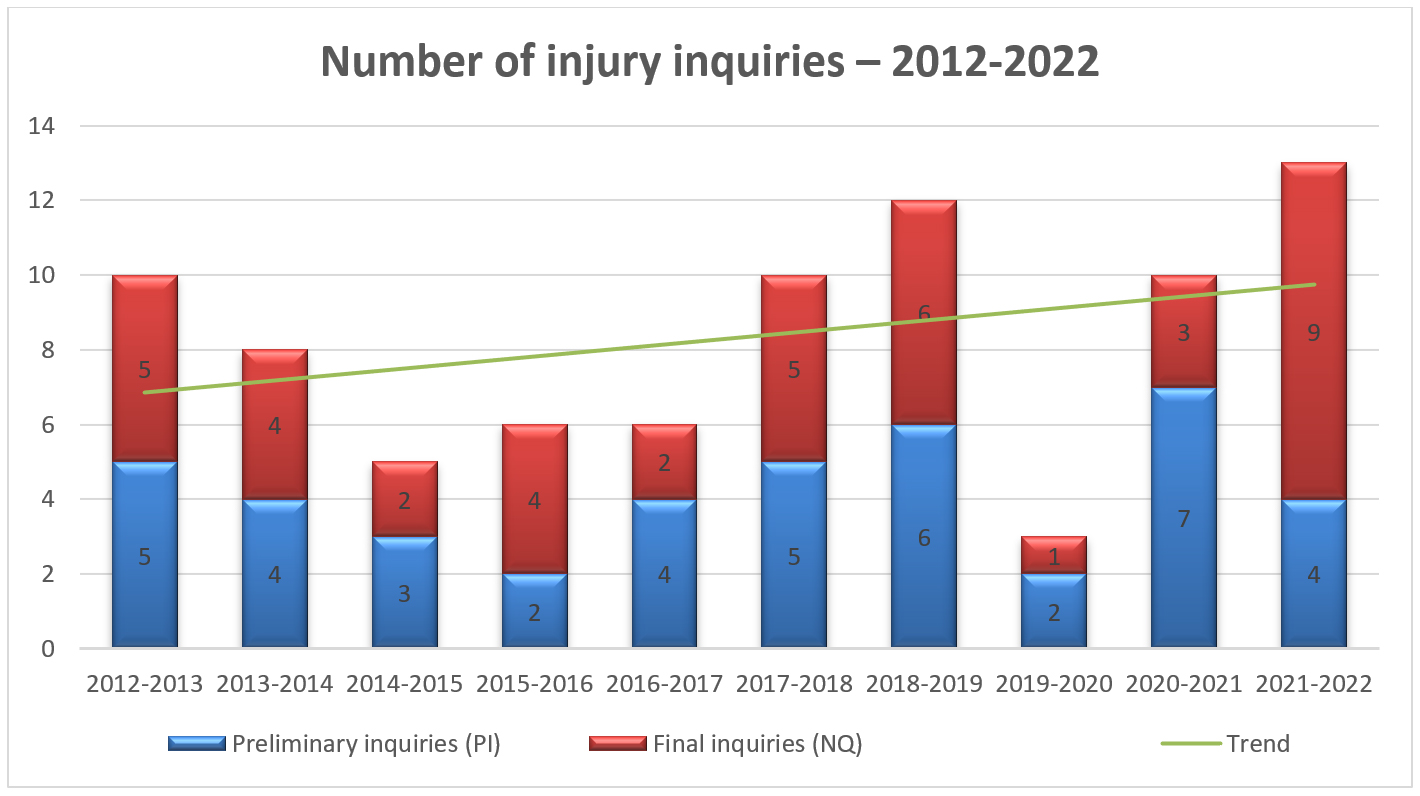
The Tribunal is experiencing a trend increase in SIMA-related activity and expects this trend to continue, in part in reaction to a challenging global trade environment and in part due to a high percentage of inquiries and reviews that result in the imposition of trade remedy measures.
Historical data shows an increase in the number of cases coming before the Tribunal. Particularly noticeable is the increase in the number of preliminary injury and injury investigations conducted this year and over the last ten years, as indicated in the graph below.
In Budget 2021, the Government signalled its intention to launch public consultations on measures to strengthen Canada’s trade remedy system and to improve access to the trade remedy system for workers, unions and small and medium-sized enterprises (SMEs). Budget 2022 announced the Government’s intention to introduce changes to SIMA and to the Canadian International Trade Tribunal Act to better ensure that unfairly traded goods are subject to duties and increase the participation of workers. These changes, if implemented, may make it easier to bring forward trade remedies cases and further encourage the use of Canada’s trade remedies mechanisms—potentially leading to a rise in the average number of cases filed with the Tribunal each year.
Expiry reviews
Initiation of expiry reviews (LE)
SIMA provides that a finding or order expires after five years unless an expiry review has been initiated. No later than two months before the expiry date of the finding or order, the Tribunal publishes a notice of expiry. The notice invites interested persons to submit their views on whether the order or finding should be reviewed. If the Tribunal determines that an expiry review is not warranted, it issues an order with reasons for its decision. Otherwise, it initiates an expiry review.
The Tribunal completed six initiations of expiry reviews during the fiscal year concerning flat hot-rolled carbon and alloy steel sheet and strip, welded large diameter carbon and alloy steel line pipe, copper pipe fittings, gypsum board, pup joints and concrete reinforcing bar.
| LE-2021-001 | LE-2021-002 | LE-2021-003 | LE-2021-004 | LE-2021-005 | LE-2021-006 | LE-2021-007 | |
|---|---|---|---|---|---|---|---|
| Product | Flat Hot-rolled Carbon and Alloy Steel Sheet and Strip | Welded Large Diameter Carbon and Alloy Steel Line Pipe | Copper Pipe Fittings | Gypsum Board | Pup Joints | Concrete Reinforcing Bar | Certain Fabricated Industrial Steel Components |
| Type of case | Dumping / subsidizing | Dumping / subsidizing | Dumping / subsidizing | Dumping | Dumping and subsidizing | Dumping | Dumping / subsidizing |
| Country | Dumping: Brazil, China and Ukraine Subsidizing: India |
Dumping: China and Japan Subsidizing: China |
Dumping: United States, South Korea and China Subsidizing: China |
United States | China | Belarus, Chinese Taipei, Hong Kong, Japan, Portugal and Spain | Dumping: China, South Korea and Spain Subsidizing: China |
| Date of decision | July 9, 2021 | September 27, 2021 | September 27, 2021 | December 13, 2021 | February 24, 2022 | March 29, 2022 | Pending |
| Decision | Expiry review initiated | Expiry review initiated | Expiry review initiated | Expiry review initiated | Expiry review initiated | Expiry review initiated | In progress |
| Participants | 7 | 7 | 5 | 7 | 1 | 8 |
Expiry reviews (RR)
When the Tribunal initiates an expiry review of a finding or an order, it issues a notice of expiry review and notifies the CBSA of its decision.
The purpose of an expiry review is to determine whether the imposition of anti-dumping or countervailing duties remains necessary. There are two phases in an expiry review. The first phase is the investigation by the CBSA to determine whether there is a likelihood of resumed or continued dumping or subsidizing if the finding or order expires. If the CBSA determines that such likelihood exists with respect to any of the goods, the second phase is the Tribunal’s inquiry into the likelihood of injury or retardation arising from the resumption or continuation of the dumping or subsidizing. If the CBSA determines that there is no likelihood of resumed dumping or subsidizing for any of the goods, the Tribunal does not consider the goods in its subsequent determination of the likelihood of injury, and it issues an order rescinding the order or finding with respect to them.
The Tribunal’s procedures in expiry reviews are similar to those in final injury inquiries (NQ). Upon completion of an expiry review, the Tribunal issues an order with reasons, rescinding or continuing a finding or order, with or without amendment. If a finding or order is continued, it remains in force for a further five years, unless an interim review is initiated, and the finding or order is rescinded. If the finding or order is rescinded, imports are no longer subject to anti-dumping or countervailing duties.
The Tribunal completed four expiry reviews in the fiscal year concerning whole potatoes, refined sugar, carbon and alloy steel line pipe, and steel grating.
| RR-2020-002 | RR-2020-003 | RR-2020-004 | RR-2020-005 | |
|---|---|---|---|---|
| Product | Certain Whole Potatoes | Refined Sugar | Carbon and Alloy Steel Line Pipe | Steel Grating |
| Type of case | Dumping | Dumping / subsidizing | Dumping and subsidizing | Dumping and subsidizing |
| Country | United States | Dumping: United States, Denmark, Germany, Netherlands and United Kingdom Subsidizing: European Union |
China | China |
| Date of decision | June 2, 2021 | August 6, 2022 | January 6, 2022 | February 2, 2022 |
| Decision | Order continued | Order continued | Finding continued | Order continued |
| Questionnaires received | 40 | 19 | 28 | 31 |
| Participants | 20 | 6 | 5 | 1 |
| RR-2021-001 | RR-2021-002 | RR-2021-003 | RR-2021-004 | RR-2021-005 | RR-2021-006 | |
|---|---|---|---|---|---|---|
| Product | Flat Hot-rolled Carbon and Alloy Steel Sheet and Strip | Welded Large Diameter Carbon and Alloy Steel Line Pipe | Copper Pipe Fittings | Gypsum board | Pup Joints | Concrete Reinforcing Bar |
| Type of case | Dumping / subsidizing | Dumping / subsidizing | Dumping / subsidizing | Dumping | Dumping and subsidizing | Dumping |
| Country | Dumping: Brazil, China and Ukraine Subsidizing: India |
Dumping: China and Japan Subsidizing: China |
Dumping: United States, South Korea and China Subsidizing: China |
United States | China | Belarus, Chinese Taipei, Hong Kong, Japan, Portugal and Spain |
| Date of decision | In progress | In progress | In progress | In progress | In progress | In progress |
Historical trend: expiry reviews
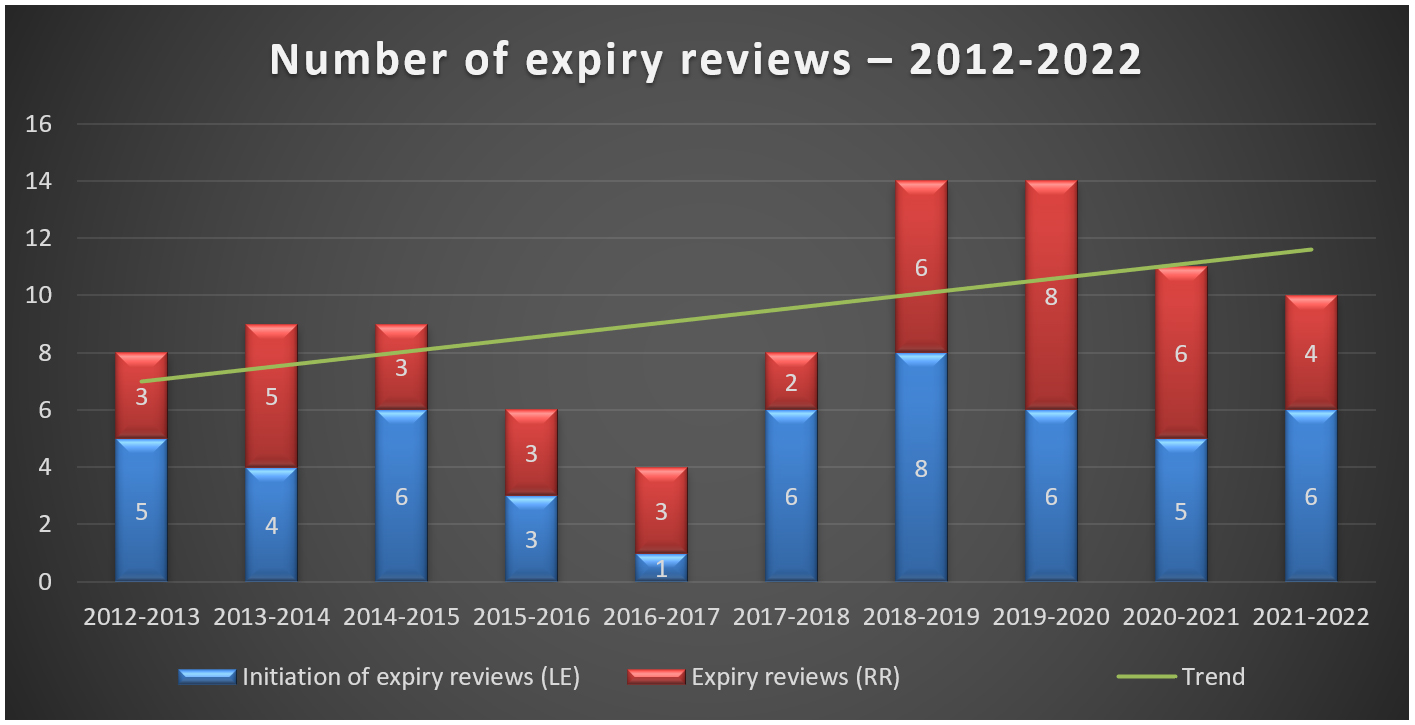
Anti-dumping and countervailing findings expire after five years unless an expiry review is initiated to determine whether the measures remain necessary. The number of annual expiry reviews has gradually increased over a ten-year period, from an average of three expiry reviews for the 2012-17 period to five for the 2017-22 period. Most inquiries and expiry reviews in recent years have led to the imposition or continuation of measures. As shown in the graph on the next page, this creates a cyclical but gradual upward trend pressure on the caseload of the Tribunal. For example, there are now 49 injury findings in force
Public interest inquiries (PB)
At the request of an interested person or on its own initiative, the Tribunal may initiate a public interest inquiry following an injury finding if the Tribunal is of the opinion that there are reasonable grounds to consider that the imposition of all or part of the duties may not be in the public interest. In cases where it concludes that such duties are not in the public interest, the Tribunal will issue a report to the Minister of Finance recommending that the duties be reduced and by how much.
The Tribunal received one request for a public interest inquiry during the fiscal year concerning concrete reinforcing bar. It did not proceed to the inquiry stage, as the request was not properly documented.
Interim reviews (RD)
The Tribunal may conduct an early review of its findings of injury or threat of injury, or other related orders at any time, on its own initiative or at the request of the Minister of Finance, the CBSA or any other person or government. This is an interim review. An interim review may be warranted where there is a reasonable indication that new facts have arisen or if the circumstances that led to the finding or order have changed. Where the Tribunal commences an interim review, it determines if the finding or order (or any aspect of it) should be rescinded or continued to its expiry date, with or without amendment.
The Tribunal conducted two interim reviews in 2021-22. For the interim review concerning welded large diameter carbon and alloy steel line pipe, the Tribunal granted a product exclusion and amended its finding accordingly. For the refined sugar interim review, the Tribunal was not convinced that an interim review was warranted and therefore did not conduct one.
| Request for interim review RD-2020-002 | Interim review RD-2020-003 | |
|---|---|---|
| Product | Refined Sugar | Welded Large Diameter Carbon and Alloy Steel Line Pipe |
| Type of case | Dumping / subsidizing | Product exclusion |
| Country | Dumping: United States, Denmark, Germany, Netherlands and United Kingdom Subsidizing: European Union |
China and Japan |
| Date of decision | April 27, 2021 | April 16, 2021 |
| Decision | No interim review | Finding amended |
Requests for importer ruling (MP)
Where a question arises as to which of two or more persons is the importer in Canada of goods imported or to be imported into Canada and on which SIMA duties are payable, or has been paid or will be payable if the goods are imported, the President of the CBSA may request that the Tribunal issue a ruling on that question. Any person interested in the importation of the goods may also make such a request.
Requests for importer rulings are rare; the last such Tribunal proceeding was in 2003 04. This year, following a request from the CBSA, the Tribunal initiated one such proceeding for certain oil country tubular goods. At year-end, it was still ongoing.
Sample of noteworthy decisions under the dumping and subsidizing injury inquiries and expiry reviews mandate
Upholstered Domestic Seating (NQ-2021-002)
On September 2, 2021, the Tribunal issued its finding in NQ-2021-002 concerning the dumping and subsidizing of certain upholstered domestic seating (UDS; these include but are not limited to seating such as sofas, chairs, loveseats, sofa‑beds, day‑beds, futons, ottomans, stools and home‑theatre seating) from China and Vietnam. The complainant in this inquiry, Palliser Furniture Ltd., was a domestic producer of these seats, supported by a group of UDS domestic producers. The Tribunal found that the dumping and subsidizing of most of the goods covered by the inquiry had caused injury to the domestic industry.
This inquiry was notable in that it involved consumer goods where a finding would have direct implications on consumers. For instance, where UDS was deemed to be dumped, the amount of anti-dumping duties applied to Chinese imports could be as high at 188.0 percent and applied to Vietnamese imports could be as high as 179.5 percent. Further, for those goods that were found to be subsidized, countervailing duties could add up to 81.1 percent on the prices of Chinese goods and 5.5 percent on the prices of Vietnamese goods. As the Chinese and Vietnamese UDS represented over half of the Canadian market in 2020, the increase in overall UDS pricing due to anti-dumping and countervailing duties was noticeable to Canadian consumers. This was especially apparent during the investigation itself given that preliminary duties were applied to the Chinese and Vietnamese UDS at the initiation of the inquiry.
From an investigation perspective, this inquiry was remarkable for a number of reasons. Firstly, there was a lack of homogeneity within the range of UDS applicable to the definition of the goods being investigated. This diverse range of UDS added a complexity to the Tribunal’s consideration of whether imported UDS was comparable to and competed with UDS produced in Canada. Secondly, unlike most other Tribunal investigations, this investigation involved a domestic industry that consisted of a significant number of producers, not all of which were known to the complainant when it filed its complaint. Lastly, the inquiry was especially complex and involved many parties, submissions and a volume of requests for exemptions that had not been experienced by the Tribunal in over a decade.
Small Power Transformers (NQ-2021-003)
On December 24, 2021, the Tribunal issued its findings in NQ-2021-003 concerning the dumping of small power transformers having a top power handling capacity between 3 and 60 megavolt amperes, from Austria, the Separate Customs Territory of Taiwan, Penghu, Kinmen and Matsu (Chinese Taipei), and South Korea. Three major Canadian manufacturers of those transformers were the complainants in this inquiry. The Tribunal found that the dumping of transformers from Chinese Taipei and South Korea had caused material injury to the domestic industry but that the dumping of transformers from Austria had not caused injury and was not threatening to cause injury.
When an inquiry involves goods from multiple sources, the Tribunal must consider whether an assessment of the cumulative effect of the dumping of goods is appropriate. This case required a detailed analysis of the conditions of competition in the industry, which led the Tribunal to conclude that a cumulative assessment of the effect of the dumping of transformers from South Korea and Chinese Taipei was appropriate but that it was not appropriate to cumulate the effects of imports of transformers from Austria, as these did not serve the same market segments. Accordingly, the Tribunal conducted two separate injury and threat of injury analyses.
The Tribunal found that imported transformers from Chinese Taipei and South Korea significantly impacted the prices of domestic goods and caused domestic producers to lose sales. This forced domestic producers to bid aggressively to maintain sales volumes and caused material injury in the form of lost profitability and reduced plant backlogs, with downstream impacts on profitability, investments and overall growth. In contrast, the Tribunal found that transformers from Austria were imported as a result of procurements where domestic producers either did not bid or did not meet technical requirements. They were also priced higher than domestic like goods, and there were no observable price effects resulting from these imports. The Tribunal therefore concluded that the dumping of transformers from Austria had not contributed to the injury suffered by the domestic industry over the period of inquiry and that they did not present a threat of future injury.
Oil Country Tubular Goods III (NQ-2021-004)
On January 26, 2022, the Tribunal issued its decision in NQ-2021-004 concerning the dumping of oil country tubular goods (OCTG) from Mexico. This inquiry stemmed from a complaint filed with the CBSA on May 10, 2021, by Evraz Inc. NA Canada and Welded Tube of Canada Corp., two producers of OCTG in Canada. The Tribunal found that the dumping had not caused injury and was not threatening to cause injury to the domestic industry.
The case presented an unusual situation where a third domestic producer of OCTG, Tenaris Canada, was the nearly sole importer of the OCTG from Mexico as part of a global group of related companies producing OCTG in Mexico and in other countries. The Tribunal also examined the impact of Tenaris Canada’s internal transactions, pricing policies and marketing strategy for both domestically produced OCTG and its imports from Mexico and how these should be considered in the context of the Tribunal’s injury analysis.
The Tribunal found that Tenaris Canada had imported all, or nearly all, of the OCTG from Mexico over the period of inquiry and that these imports formed part of a calculated commercial strategy. Because Tenaris Canada had substantially benefited from the sale of these goods and was therefore insulated from any potential adverse effects arising from those sales, the Tribunal found it appropriate, for the purposes of its injury analysis, to exclude Tenaris Canada from the domestic industry, thereby ensuring that the aggregate data relating to the state of the domestic industry were not distorted.
The Tribunal, however, found no evidence that Tenaris Canada used its corporate structure to leverage the dumped imports in such a way that any injury resulting from Tenaris Canada’s sales of low-priced domestically produced OCTG was attributable to its imports from Mexico. Ultimately, the Tribunal found that the complainants had not been materially injured by the dumping of Mexican OCTG but rather by the impact of a number of other factors, including the existence of a major industry downturn, the COVID-19 pandemic, the destocking of inventories by independent distributors resulting in a lower level of sales by the complainants, and Tenaris Canada’s aggressive pricing of domestically produced like goods.