
Procurement reviews
To safeguard the integrity of the Government of Canada’s procurement processes, the Tribunal has been vested with the mandate of serving as an appeal mechanism for:
- inquiring into complaints by potential suppliers of goods or services to the federal government relating to designated contracts valued above certain monetary thresholds;
- determining whether procurement processes that are the subject of complaints complied with Canada’s obligations under certain trade agreements;
- considering issues such as whether bids were evaluated fairly;
- recommending remedies and awarding costs; and
- providing recommendations to federal government institutions about their procurement processes.
There are potentially up to three stages in the Tribunal’s consideration of a procurement complaint:
- Acceptance stage – Within five working days of receipt of a properly documented complaint, the Tribunal determines whether the complaint was filed within statutory deadlines, whether it concerns a procurement process subject to the Tribunal’s jurisdiction, and whether the complaint discloses a reasonable indication of breach of compliance with the trade agreements. If those conditions are met, the Tribunal begins an inquiry.
- Inquiry stage – Inquiries are completed within 45, 90, or 135 days, depending on the complexity of the matter. The Tribunal examines the complainant’s allegations, the submissions of the government institution involved in the matter, and in certain cases submissions by interested parties. If a complaint is valid, the Tribunal will recommend an appropriate remedy (for example, that a new solicitation be issued, the bids be re-evaluated or the contract be terminated).
- Compensation stage – If a complaint is valid and the Tribunal recommends compensation (i.e., a monetary award), the Tribunal asks parties to negotiate a mutually agreed amount of compensation. If parties cannot agree on an amount, the Tribunal will receive submissions and decide on an appropriate amount of compensation.
Overview of the procurement complaint process
- A potential supplier has 10 working days after the day it becomes aware, or should have become aware, of the grounds (the reasons) for the complaint to file:
- a complaint with the Tribunal.
- an objection with the government institution that is awarding the contract. If the potential supplier can’t settle its objection with the government institution, it can still bring a complaint to the Tribunal within 10 working days if they decide that the government institution is not addressing the issue to the liking of the potential supplier.
- The Tribunal reviews the complaint to determine whether it can be accepted for inquiry. The potential supplier is notified within one week if the complaint is accepted for inquiry.
- If the complaint is accepted for inquiry, the government institution has 30 days to file the Government Institution Report, which is its response to the complaint.
- The complainant has 7 working days to provide comments on the report.
- In most cases, within 90 calendar days from its receipt, the Tribunal determines whether the complaint is valid, valid in part or not valid.
- If the complainant disagrees with the Tribunal’s findings, they can ask the Federal Court of Appeal to review the matter.
Relationship between the Tribunal and the Office of the Procurement Ombudsman
Since October 1, 2020, the Office of the Procurement Ombudsman (OPO) and the Tribunal have worked under a Memorandum of Understanding (MOU). The MOU aims at easing potential suppliers’ access to the complaint review system administered by both organizations. It also provides for continued cooperation between OPO and the Tribunal. The Tribunal and OPO have concurrent jurisdiction over procurement complaints brought by Canadian suppliers as follows:
| Canadian International Trade Tribunal | Office of the Procurement Ombudsman |
|---|---|
| Goods valued at $30,300 and above | Goods valued under $30,300 |
| Services valued at $121,200 and above | Services valued under $121,200 |
The Tribunal has exclusive jurisdiction over complaints by foreign suppliers about government procurement processes under applicable trade agreements. When filing a complaint with either OPO or the Tribunal, complainants are given the option to share their contact information and the basic nature of their complaint with the other organization. This exchange enhances access to justice by ensuring that complainants are filing their complaints in the right place and, most importantly, in the timeliest manner possible. During this fiscal year, a majority of complainants chose to avail themselves of this service.
Officials from OPO and the Tribunal and its secretariat met twice in 2022-23 where they discussed each organization’s jurisdiction and how to ensure that parties have better access to justice.
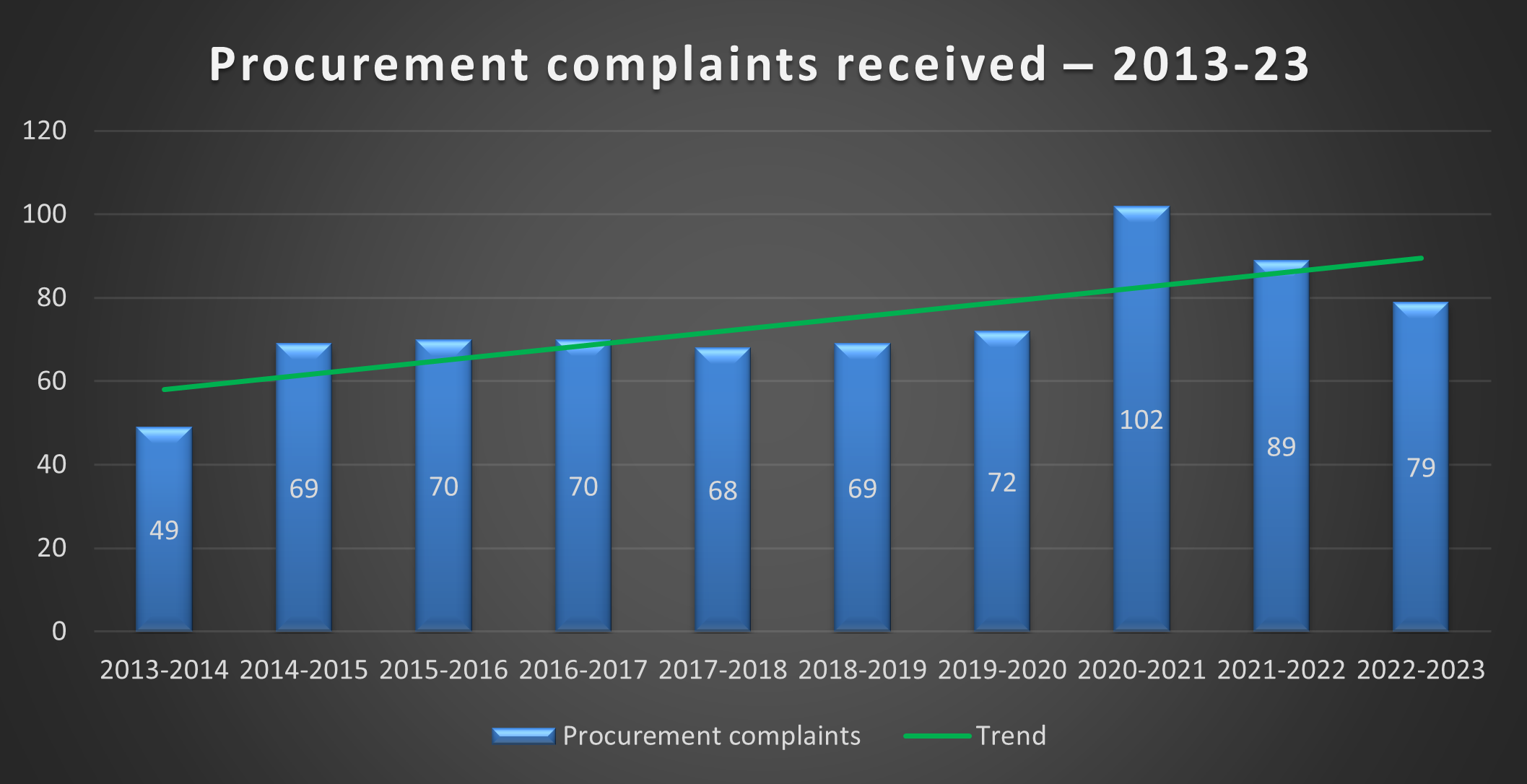
Historical trend: Procurement complaints received
The Tribunal’s caseload for its procurement review mandate remains high. As indicated in the following table, the number of complaints received by the Tribunal in 2022-23 was 61% higher than in 2013-14, with the average number of complaints received during a five-year period having increased from 65 during the 2013-18 period to 82 during the 2018-23 period. This represents an increase of 26% between periods.
Procurement review activities in 2022-23
| Carried over from previous fiscal year | 9 |
|---|---|
| Received during this fiscal year | 79 |
| Total | 88 |
| Disposed during this fiscal year | 82 |
| Outstanding at the end of fiscal year | 6 |
| Total decisions issued | 51 |
|---|---|
| Of which: | |
|
Premature/late filing |
25 |
|
Lack of jurisdiction/not a potential supplier/not a designated contract |
9 |
|
No reasonable indication of a breach |
17 |
| Withdrawn/abandoned | 9 |
| Total decisions issued | 22 |
|---|---|
| Of which: | |
|
Ceased |
8 |
|
Not valid/dismissed |
10 |
|
Valid or valid in part |
4 |
| Ongoing at the end of fiscal year | 3 |
Complaints received
Of note, this year saw a continuation in a growing trend experienced by the Tribunal. Of the 79 complaints received this year, 70 were filed by self-represented parties. In that regard, the Tribunal’s website includes a set of guidelines describing the Tribunal’s procurement inquiry mandate and procedures. Potential complainants will also find on the Tribunal’s website a procurement complaint form, in multiple formats, with a comprehensive set of instructions, that they can use to present their case to the Tribunal.
Compensation
One compensation order was issued during this fiscal year: Joe Parsons Construction Ltd. v. Department of Public Works and Government Services (PR-2020-065).
| Carried over from previous fiscal year | 3 |
|---|---|
| Initiated during this fiscal year | 0 |
| Total | 3 |
| Disposed during this fiscal year | 1 |
| Ongoing at the end of fiscal year | 2 |
Sample of noteworthy decisions under the procurement review mandate
Eight Bells Consulting Services Incorporated v. Treasury Board Secretariat (PR-2022-033)
Eight Bells Consulting Services Incorporated (Eight Bells) submitted a complaint concerning a solicitation issued by the Treasury Board Secretariat (TBS). TBS published a notice of intended procurement (NIP) indicating it needed the services of senior and junior procurement specialists. The tender was only open to entities that held a supply arrangement in the relevant service category. Fifteen supply arrangement holders were invited to bid on the solicitation, but other qualified suppliers could request an invitation. Eight Bells asked for a copy of the solicitation documents, indicating it too was a supply arrangement holder and possibly interested in participating. This request was denied by TBS, essentially on the basis that Eight Bells was not a qualified supplier for this solicitation.
In its complaint to the Tribunal, Eight Bells argued that the NIP did not include a sufficient description of the tender requirements, contrary to Article VII 2.6 of the World Trade Organization Agreement on Government Procurement (WTO-AGP). The Tribunal noted that, although the NIP did disclose certain details about the procurement, it did not contain all the particulars that Eight Bells required to make an informed decision on whether it was qualified or able to bid, which the Tribunal considered was the purpose underlying Article VII(2)(b) of the WTO-AGP. In the circumstances, the Tribunal found that TBS’s refusal to provide Eight Bells with the solicitation documents placed it in breach of its trade agreement obligations. The Tribunal found that TBS mistakenly assumed that providing a copy of the solicitation documents would be tantamount to inviting an unqualified bidder to submit a proposal. The Tribunal highlighted that merely receiving the solicitation documents does not confer the right to bid.
The Tribunal did not agree with Eight Bells on its remaining grounds of complaint. Namely, the Tribunal found that the NIP did not unreasonably restrict the number of bidders who could participate in this solicitation. The Tribunal also did not agree with Eight Bells that it was wrongly excluded from participating in the tender. The Tribunal found that a procuring entity should not have to adjust the terms of its tender to accommodate a particular bidder. The Tribunal also found that TBS’s refusal to invite Eight Bells to compete on this requirement because it was not a fully qualified supplier was consistent with applicable obligations. As a result, the Tribunal found the complaint to be valid in part.
ProWear Inc. v. Department of Public Works and Government Services (PR-2021-080)
The complaint by ProWear Inc. also related to access by bidders to information about a procurement process. This complaint concerned an ongoing multi-phased procurement process. ProWear argued that by requiring bidders to submit a financial offer under the first phase of this process, and before the point-rated evaluation criteria were made available as part of a subsequent phase of the procurement process, the Department of Public Works and Government Services (PWGSC) failed to provide bidders with sufficient detail about the procurement to allow for fair competition. ProWear objected to PWGSC, taking the position that to submit a financial offer, it needed to get a complete understanding of the requirements and their evaluation. PWGSC declined to amend the solicitation further to ProWear’s objection on this point and indicated that it could file a complaint with the Tribunal should it wish to pursue its grievance.
Following the filing of ProWear’s complaint with the Tribunal, PWGSC amended the structure of the solicitation to allow bidders earlier access to the point-rated evaluation criteria at issue and pushed the submission of financial offers to a later stage of the procurement process. Before the Tribunal, PWGSC submitted that these amendments addressed the concerns raised by ProWear and that the complaint should therefore be dismissed.
The Tribunal found that the amendments addressed the concerns raised by ProWear and made ProWear’s complaint moot. However, the Tribunal found that ProWear was entitled to costs since it raised legitimate issues and bore the effort and expense of bringing the complaint before the Tribunal. The Tribunal noted that PWGSC had summarily denied ProWear’s objection at the outset and invited ProWear to file a complaint with the Tribunal. However, the submissions before the Tribunal suggested that a complaint would likely have been avoided had ProWear’s grievances been carefully considered and remedied by PWGSC during the objection process. Ultimately, the Tribunal decided to cease its inquiry into the complaint and awarded ProWear costs in the nominal amount of $500.
Chantier Davie Canada Inc. and Wärtsilä Canada Inc. v. Department of Public Works and Government Services (PR-2022-053)
This complaint related to an invitation to tender (ITT) made by PWGSC on behalf of the Department of Fisheries and Oceans (DFO) for work on the CCGS Terry Fox. In their complaint, Chantier Davie and Wärtsilä alleged that PWGSC breached trade agreement debriefing obligations and that their bid was evaluated incorrectly. They also argued that PWGSC should have declared non-compliant the winning bid, submitted by Heddle Marine Service Inc. (Heddle), on Chantier Davie and Wärtsilä’s belief that Heddle had not met certain requirements of the ITT.
The Tribunal found that PWGSC met the debriefing obligations contained in the Canadian Free Trade Agreement (CFTA). PWGSC had offered a written debriefing to Chantier Davie and Wärtsilä. The Tribunal found that the complainants had not availed themselves of the opportunity to ask any substantive questions at the debriefing stage, and that the fact that Wärtsilä and Chantier Davie were not satisfied with the written format of the debriefing offered by PWGSC did not constitute a violation of any trade agreement obligation. The Tribunal commented that debriefings beyond what might be strictly required by trade agreement obligations are a best practice for government institutions because they can serve to avoid litigation. The Tribunal also noted that aggrieved bidders should not shy away from asking a government institution to explain its decisions. In this case, Wärtsilä and Chantier Davie did not avail themselves of the debriefing process.
The Tribunal found that Wärtsilä and Chantier Davie’s allegations that PWGSC failed to properly evaluate Heddle’s bid did not disclose a reasonable indication of a breach of the CFTA, because they were made without providing evidence at the time of filing the complaint. The Tribunal noted that the Canadian International Trade Tribunal Act (CITT Act) requires that a complaining party demonstrate a reasonable indication of a breach of any alleged trade agreement obligation when filing its complaint and states that a reasonable indication of a breach of a trade agreement obligation cannot be demonstrated on allegations alone; evidence supporting an allegation is required. The Tribunal noted that its process cannot be used for evidence gathering or to conduct a “fishing expedition”. The Tribunal dismissed the complaint concerning these grounds of complaint, as they were not presented with supporting evidence at the time of filing the complaint.
With respect to the ground of complaint concerning the evaluation of the complainants’ bid, the Tribunal found that PWGSC had applied latently ambiguous evaluation criteria to declare Chantier Davie and Wärtsilä’s bid non-compliant. Pursuant to subsections 30.15(2) and (3) of the CITT Act, the Tribunal recommended that PWGSC remedy the breach of the CFTA by re-evaluating the bids received in response to the solicitation, and determined that each party was to bear its own costs.
Gregory Kerr Limited v. Department of Public Works and Government Services (PR-2021-058)
This complaint related to an ITT by PWGSC on behalf of DFO for urgent structural repairs to a floating dock in Nova Scotia. The complainant, Gregory Kerr Limited (GKL), submitted the lowest bid by the closing date, but PWGSC disqualified the bid, having found that the validity of the bid bond provided by GKL could not be verified. GKL challenged the disqualification of its bid.
The Tribunal determined that the complaint was not valid. The Tribunal found that the ITT required bidders to provide security and prescribed mandatory criteria to provide valid security. Although GKL had obtained a verifiable bond from its surety, that bond was not transmitted, in either original or verifiable form, to PWGSC. The Tribunal found that this was not attributable to any ambiguity in the language used by the ITT. Instead, the Tribunal found, on the balance of probabilities, that the evidence before it showed that the bond document was handled by the bidder (namely, by the action of “dragging and dropping” the bond “into” other bid documents) in a manner contrary to the explicit instructions of the surety responsible for issuance of the bond, which caused the document to become non-verifiable by PWGSC in accordance with the parameters set out in the ITT.
The Tribunal also observed that, in drafting the ITT, PWGSC had designed stringent tender requirements that limit its discretion in ascertaining whether a bidder has provided valid bid security. As a practical matter, this leaves PWGSC little room to retain a lower-priced bid where verification of bid security fails for what may be characterized as a technicality. However, once the rules of the competition are fixed, the Tribunal’s review is limited to ensuring that the rules have been followed.
The Tribunal found no grounds to conclude that PWGSC acted unreasonably in finding that GKL had failed to meet a mandatory criterion of the ITT and disqualifying its bid on this basis. The complaint was dismissed, and the Tribunal awarded costs to PWGSC.
Joe Parsons Construction Ltd. (JPCL) v. Department of Public Works and Government Services (PR-2020-065)
Joe Parsons Construction Ltd. (JPCL) successfully brought a complaint regarding a solicitation process issued by PWGSC for the provision of labour, equipment and materials to perform miscellaneous minor earthworks for the regional office of Cape Breton Operations in Sydney, Nova Scotia. Having determined that the complaint was valid, the Tribunal recommended, among a series of eventual remedies, that PWGSC compensate JPCL for the profits that it lost from call-ups issued against the standing offer based on its ranking in a re-evaluation undertaken following the Tribunal’s decision. As the parties were unable to agree on the amount of compensation, the Tribunal received submissions on this issue and, in June 2022, issued its order recommending an appropriate amount of compensation.
The Tribunal noted that the CITT Act and related regulations do not provide any guidance regarding compensation matters. To guide its analysis, the Tribunal referred to its procurement compensation guidelines, which provide that the Tribunal will attempt to place the complainant in the position it would have been but for the government’s breach of the trade agreements. Further, as noted previously by the Tribunal, the goal is to determine compensation using a transparent methodology that is simple yet fair, that can be applied using reliable evidence or assumptions that are reasonably supported, and that is verifiable by the opposing parties and the Tribunal in a non-onerous manner.
In this case, PWGSC submitted, and JPCL agreed, that JPCL would have earned a total revenue of $450,000.00 as the second-ranked standing offer holder. To determine the amount of profit JPCL would have earned as the second-ranked standing offer holder, that is, from the total revenue of $450,000.00, the Tribunal found it appropriate to consider the extent to which PWGSC purchased or intended to purchase labour, equipment and materials from the current second-ranked standing offer holder. Further, to determine a profit margin for each line item, the Tribunal turned to the costs claimed by JPCL for each line item and considered whether the costs claimed were reasonable, having regard to the evidence submitted. Ultimately, the Tribunal calculated JPCL’s lost profit as an amount equal to $199,654.08.
In arriving at this conclusion, the Tribunal found that lost profit calculations should not reflect any claimed benefits from the Canada Emergency Response Benefit (CERB) program. JPCL’s claim in this regard was unsupported. Further, the Tribunal found that the CERB wage subsidy does not form part of the business’s profit earned under a contract payable by PWGSC, and, as such, given that compensation awards are based on the value of the contract, it would be inappropriate for the Tribunal to factor it into its compensation analysis.