
Dumping and subsidizing injury inquiries and expiry reviews
Under the Special Import Measures Act (SIMA), the Canada Border Services Agency (CBSA) may impose anti-dumping and countervailing duties if Canadian producers are injured by imports of goods into Canada:
- that have been sold at prices lower than the price of similar goods in the foreign producer’s home market or at prices that do not cover costs and a reasonable amount for profits (dumping), or
- that have benefited from certain types of government grants or other assistance (subsidizing).
The CBSA makes the determination as to whether dumping and subsidizing has occurred. The Tribunal determines whether such dumping or subsidizing has caused, or is threatening to cause, injury to a domestic industry or has caused delay to the establishment of a domestic industry.
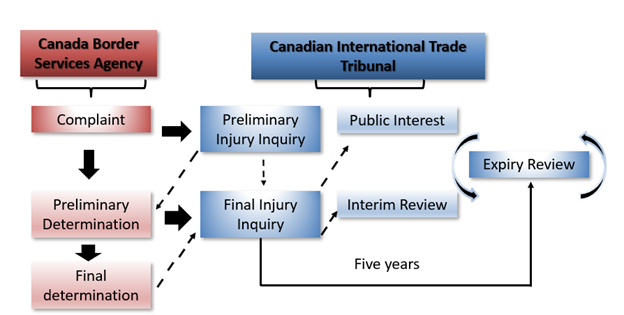
Special Import Measures Act process chart
Injury inquiries
Preliminary injury inquiries (PI)
A Canadian producer or an association of Canadian producers begins the process of seeking relief from alleged injurious dumping or subsidizing by making a complaint to the CBSA. If the CBSA initiates a dumping or subsidizing investigation, the Tribunal initiates a preliminary injury inquiry under SIMA.
In a preliminary injury inquiry, the Tribunal determines whether the evidence discloses a reasonable indication that the dumping or subsidizing has caused injury or retardation or is threatening to cause injury.
If there’s no reasonable indication that the dumping or subsidizing has caused injury or retardation or is threatening to cause injury, the Tribunal terminates the inquiry, and the CBSA terminates the dumping or subsidizing investigation. The Tribunal issues a determination and reasons.
The Tribunal completed two preliminary injury inquiries in the fiscal year concerning certain mattresses and drill pipe. These preliminary injury inquiries were initiated in the previous fiscal year. No preliminary injury inquiries were initiated in the 2022-23 fiscal year.
| PI-2021-005 | PI-2021-006 | |
|---|---|---|
| Product | Mattresses | Drill pipe |
| Type of case | Dumping and subsidizing | Dumping and subsidizing |
| Country | China | China |
| Date of decision | April 25, 2022 | May 24, 2022 |
| Determination | Reasonable indication of injury | No reasonable indication of injury, retardation or threat of injury |
| Participants | ||
|
• in support of complaint |
2 | 1 |
|
• opposed to the complaint |
0 | 1 |
|
• no views expressed |
5 | 0 |
| Total | 7 | 2 |
Final injury inquiries (NQ)
If the CBSA makes a preliminary determination of dumping or subsidizing, the Tribunal commences a final injury inquiry pursuant to SIMA. The CBSA may levy provisional duties on imports from the date of the preliminary determination and continues its investigation until it makes a final determination of dumping or subsidizing.
The Tribunal must issue its finding within 120 days from the date of the CBSA’s preliminary determination of dumping or subsidizing. The Tribunal has an additional 15 days to issue reasons supporting its finding. A Tribunal finding of injury or retardation or threat of injury to a domestic industry is required for the imposition of anti-dumping or countervailing duties by the CBSA. The finding remains in place for up to five years.
The Tribunal initiated and completed one final injury inquiry this fiscal year concerning mattresses.
| NQ-2022-001 | |
|---|---|
| Product | Mattresses |
| Type of case | Dumping and subsidizing |
| Country | China |
| Date of finding | November 11, 2022 |
| Finding | Injury |
| Questionnaires received | 64 |
| Witnesses heard | 13 |
| Participants | |
|
• in support of complaint |
5 |
|
• opposed to the complaint |
0 |
|
• no views expressed |
3 |
| Total | 8 |
Historical trend: Injury inquiries
While the number of inquiries in fiscal year 2022-23 was lower than the year before, the Tribunal continues to experience a long-term trend increase in SIMA-related activity, in part in reaction to a challenging global trade environment and in part due to a high percentage of inquiries and reviews that result in the imposition of trade remedy measures.
Budget 2022 announced the Government’s intention to introduce changes to SIMA and to the Canadian International Trade Tribunal Act to better ensure that unfairly traded goods are subject to duties and increase the participation of workers. These changes may make it easier to bring forward trade remedy cases and further encourage the use of Canada’s trade remedy mechanisms—potentially leading to a rise in the average number of cases filed with the Tribunal in the long term.
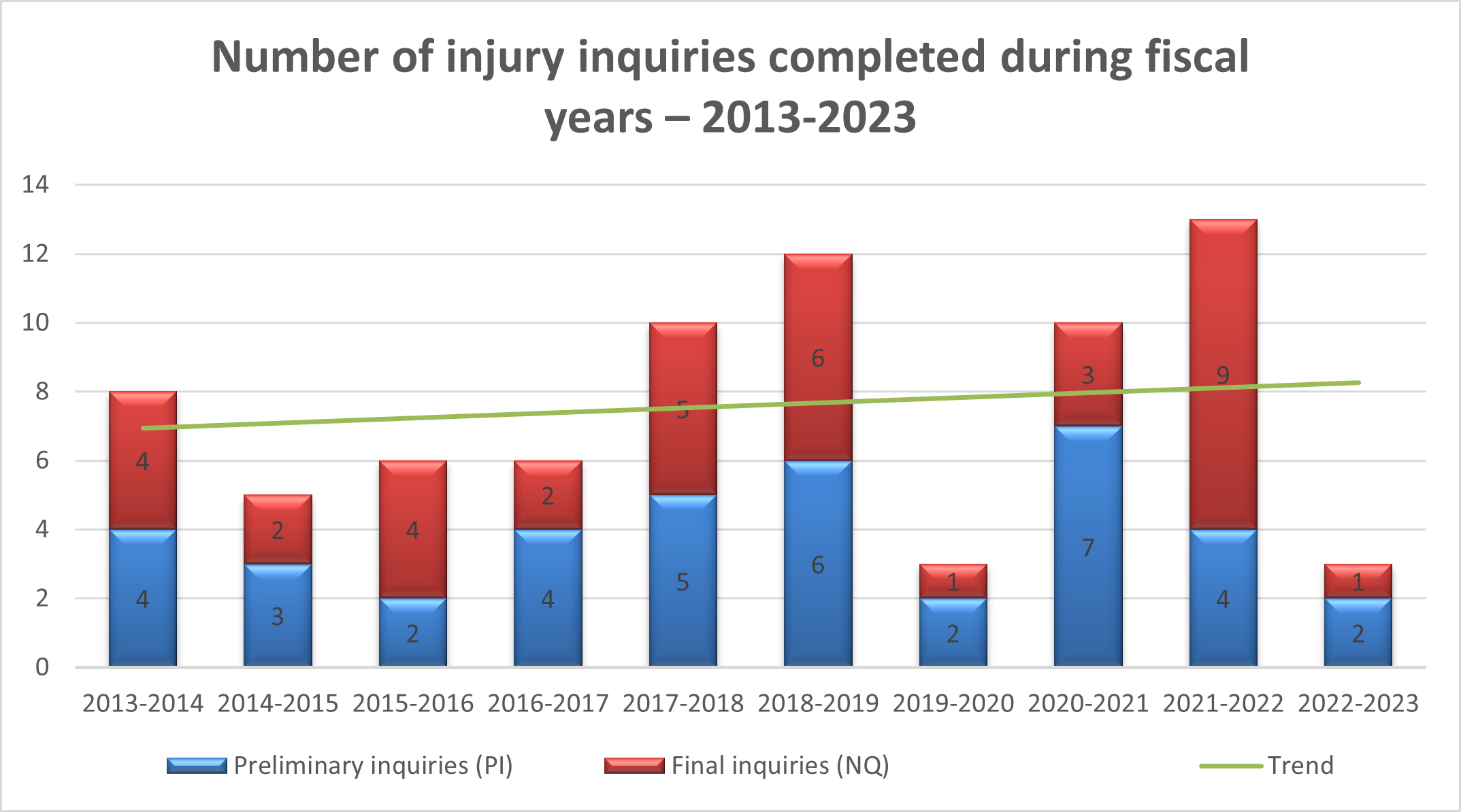
The Tribunal initiated one expiry review by way of the LE process in fiscal year 2022-23 before the process was abolished on June 22, 2022.
Expiry reviews
Initiation of expiry reviews (LE)
As a result of the amendments to SIMA that came into force on June 23, 2022, the Tribunal is now required to initiate an expiry review with respect to an order or finding every five years. Prior to those amendments coming into force, the Tribunal only initiated an expiry review if it determined that such a review was warranted. No later than two months before the expiry date of the order or finding, the Tribunal published a notice of expiry. The notice invited interested persons to submit their views on whether the order or finding should be reviewed. If the Tribunal determined that an expiry review was not warranted, it issued an order with reasons for its decision. Otherwise, it initiated an expiry review.
Prior to June 23, 2022, the Tribunal considered whether an expiry review of its finding concerning fabricated industrial steel components was warranted.
| LE-2021-007 | |
|---|---|
| Product | Certain fabricated industrial steel components |
| Type of case | Dumping and subsidizing |
| Country | Dumping: China, South Korea and Spain Subsidizing: China |
| Date of Decision | April 19, 2022 |
| Decision | Expiry review not initiated |
| Participants | |
|
• in support of review |
0 |
|
• opposed to the review |
3 |
|
• no views expressed |
0 |
| Total | 3 |
Expiry reviews (RR)
Upon initiating an expiry review of an order or finding, the Tribunal issues a notice of expiry review.
The purpose of an expiry review is to determine whether the imposition of anti-dumping or countervailing duties remains necessary. There are two phases in an expiry review. The first phase is the investigation by the CBSA to determine whether there is a likelihood of resumed or continued dumping or subsidizing if the order or finding expires. If the CBSA determines that such likelihood exists with respect to any of the goods, the second phase is the Tribunal’s inquiry into the likelihood of injury or retardation arising from the resumption or continuation of the dumping or subsidizing. If the CBSA determines that there is no likelihood of resumed dumping or subsidizing for any of the goods, the Tribunal does not consider the goods in its subsequent determination of the likelihood of injury, and it issues an order rescinding the order or finding with respect to those goods.
The Tribunal’s procedures in expiry reviews are similar to those in final injury inquiries (NQ). Upon completion of an expiry review, the Tribunal issues an order with reasons, rescinding or continuing an order or finding, with or without amendment. If an order or finding is continued, it remains in force for a further five years, unless an interim review is initiated and the order or finding is rescinded. If the order or finding is rescinded, imports are no longer subject to anti-dumping or countervailing duties.
The Tribunal completed six expiry reviews in the fiscal year concerning flat hot rolled carbon and alloy steel sheet and strip, welded large diameter carbon and alloy steel line pipe, copper pipe fittings, gypsum board, pup joints and concrete reinforcing bar. These expiry reviews were initiated in the previous fiscal year. The Tribunal also initiated five expiry reviews after June 23, 2022, concerning carbon and alloy steel line pipe, stainless steel sinks, copper pipe fittings, liquid dielectric transformers and piling pipe. These expiry reviews were in progress at the end of the fiscal year.
| RR-2021-001 | RR-2021-002 | RR-2021-003 | RR-2021-004 | RR-2021-005 | RR-2021-006 | |
|---|---|---|---|---|---|---|
| Product | Flat hot-rolled carbon and alloy steel sheet and strip | Welded large diameter carbon and alloy steel line pipe | Copper pipe fittings | Gypsum board | Pup joints | Concrete reinforcing bar |
| Type of case | Dumping / subsidizing | Dumping / subsidizing | Dumping / subsidizing | Dumping | Dumping / subsidizing | Dumping |
| Country | Dumping: Brazil, China and Ukraine Subsidizing: India |
Japan and China | United States, South Korea, China | United States | China | Belarus, Chinese Taipei, Hong Kong, Japan, Portugal and Spain |
| Date of decision | May 13, 2022 | August 3, 2022 | September 14, 2022 | October 19, 2022 | December 29, 2022 | February 2, 2023 |
| Determination | Order continued for Brazil, China and India Order rescinded for Ukraine | Finding continued | Order continued | Finding continued | Order continued | Finding continued |
| Questionnaires received | 53 | 32 | 33 | 13 | 29 | 27 |
| Witnesses heard | 18 | 8 | 0 | 16 | 0 | 13 |
| Participants | ||||||
|
• in support of complaint |
5 | 2 | 2 | 6 | 3 | 5 |
|
• opposed to the complaint |
2 | 3 | 0 | 3 | 0 | 1 |
|
• no views expressed |
3 | 1 | 0 | 1 | 0 | 1 |
| Total | 10 | 6 | 2 | 10 | 3 | 7 |
Historical trend: Expiry reviews
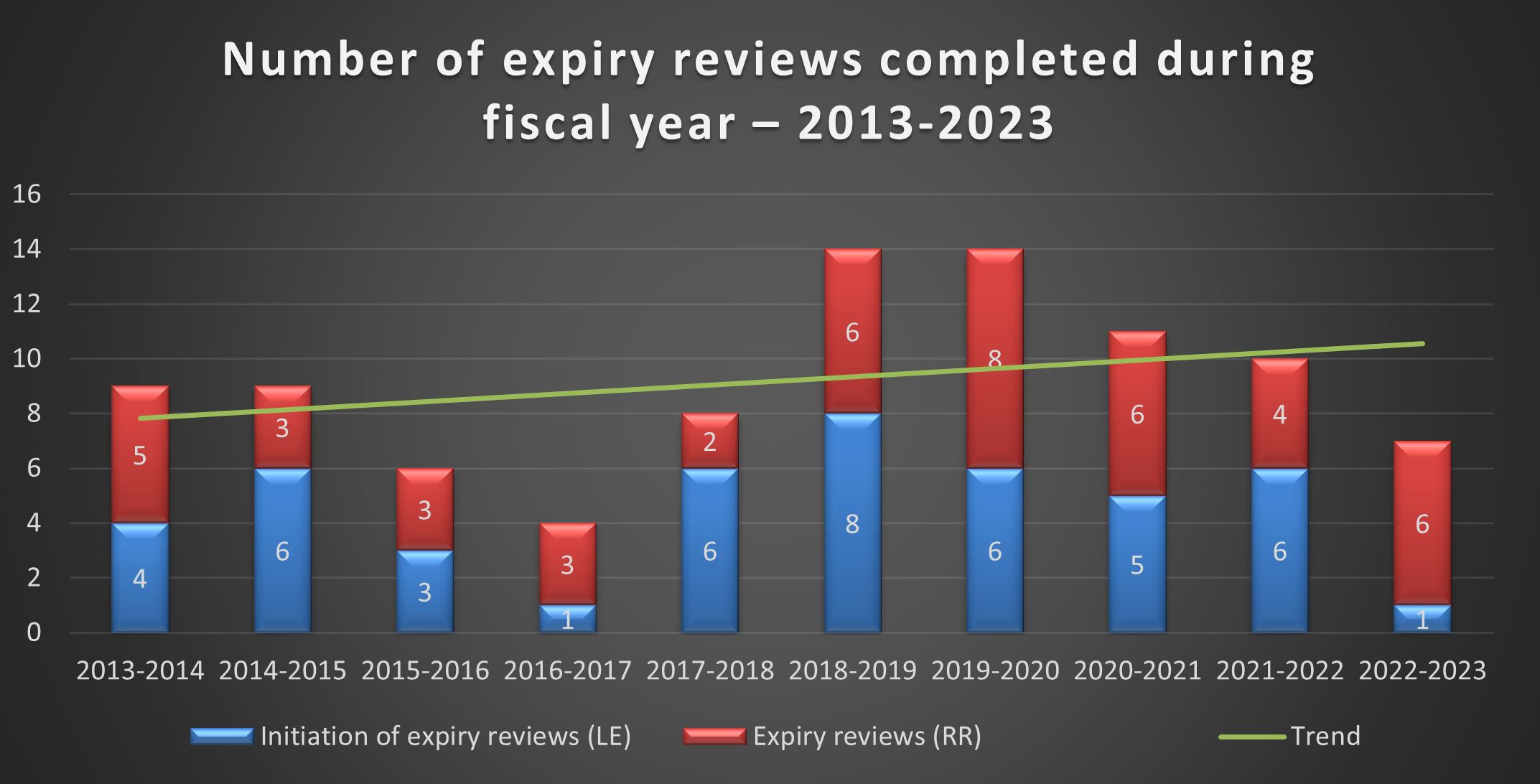
Anti-dumping and countervailing findings must be reviewed every five years to determine whether the measures remain necessary. The number of expiry reviews completed each year has gradually increased over a ten-year period, from an average of three expiry reviews for the 2013-18 period to six for the 2018-23 period. Most inquiries and expiry reviews in recent years have led to the imposition or continuation of measures. As shown in the following graph, this creates a cyclical but gradual upward trend pressure on the caseload of the Tribunal. For example, there are now 49 injury findings in force
Reviews following a request from the Minister of Finance
At any time after the issuance of a recommendation or ruling by the Dispute Settlement Body of the World Trade Organization (WTO), the Minister of Finance may, pursuant to section 76.1 of SIMA, request that the Tribunal review any order or finding.
The Tribunal completed two reviews pursuant to section 76.1 of SIMA in the fiscal year concerning hot-rolled carbon steel plate (NQ-2013-005R) and oil country tubular goods (NQ-2014-002R). In both cases, the Tribunal continued its previously established findings with amendment.
Public interest inquiries (PB)
At the request of an interested person or on its own initiative, the Tribunal may initiate a public interest inquiry following an injury finding if the Tribunal is of the opinion that there are reasonable grounds to consider that the imposition of all or part of the duties may not be in the public interest. In cases where it concludes that such duties are not in the public interest, the Tribunal will issue a report to the Minister of Finance recommending that the duties be reduced and by how much.
The Tribunal did not conduct any public interest inquiries during the fiscal year.
Interim reviews (RD)
The Tribunal may conduct an early review of its findings of injury or threat of injury, or other related orders at any time, on its own initiative or at the request of the Minister of Finance, the CBSA or any other person or government. This is an interim review. An interim review may be warranted where there is a reasonable indication that new facts have arisen or if the circumstances that led to the finding or order have changed. Where the Tribunal commences an interim review, it determines if the finding or order (or any aspect of it) should be rescinded or continued to its expiry date, with or without amendment.
The Tribunal did not conduct any interim reviews during the fiscal year.
Requests for importer ruling (MP)
Where a question arises as to which of two or more persons is the importer in Canada of goods imported or to be imported into Canada and on which SIMA duties are payable or have been paid, or will be payable if the goods are imported, the President of the CBSA may request that the Tribunal issue a ruling on that question. Any person interested in the importation of the goods may also make such a request.
Requests for importer rulings are rare; the last such Tribunal proceeding was in 2003 04. This year, the Tribunal completed one such proceeding for certain oil country tubular goods.
Sample of noteworthy decisions under the Special Import Measures Act mandate
Mattresses (NQ-2022-001)
On November 4, 2022, the Tribunal issued its finding in inquiry NQ-2022-001 concerning the dumping and subsidizing of certain mattresses from China (subject goods). The complainants in this injury inquiry were Restwell Mattress Co. Ltd. (Restwell), a domestic producer of similar mattresses, and the United Steelworkers (USW), a union representing employees that manufacture these mattresses. The complaint was supported by other domestic producers of similar mattresses. The Tribunal found that the dumping and subsidizing of the subject goods had caused injury to the domestic industry.
This injury inquiry was noteworthy for several reasons. First, unlike most other Tribunal investigations, the domestic industry consisted of a significant number of producers, some of which were unknown to the complainants when they filed their complaint. Second, the complaint was unopposed, which is unusual for consumer products. Third, the USW alleged that injury had been caused by a massive importation of subject goods prior to the imposition of preliminary duties by the CBSA. There has only been a handful of such allegations raised by complainants in the past decade.
The Tribunal found that, although imported mattresses from China were priced significantly lower than the domestic goods, they did not significantly depress or suppress the prices of those domestic goods. However, the Tribunal found that the domestic industry lost sales and significant market share to increasing imports of subject goods throughout the period of inquiry. In turn, the Tribunal found that this had a negative impact on domestic production, profitability, employment and investments.
With respect to the alleged massive importation, the Tribunal found that there had been a considerable importation of dumped goods that caused injury in a period prior to the issuance of the CBSA’s preliminary determination. Additionally, the Tribunal found that there had been a series of importations that, in the aggregate, were massive and occurred within a relatively short period of time. However, with respect to its assessment of whether duties were necessary to prevent the recurrence of injury, the Tribunal determined, based on historical inventory patterns, that the duration of time for the excess inventory resulting from the massive importation to likely be absorbed by the market represented less than two weeks of consumption in the domestic market. Thus, the Tribunal held that a finding of massive importation was not warranted.
Drill Pipe (PI-2021-006)
On May 24, 2022, the Tribunal issued its preliminary determination of injury in PI-2021-006 concerning the dumping and subsidizing of drill pipe from China (subject goods). The complaint that led to this preliminary injury inquiry was filed with the CBSA by Command Drilling Products Ltd. (CDP). The Tribunal concluded that the evidence did not disclose a reasonable indication that the dumping and subsidizing of the subject goods had caused injury or retardation or was threatening to cause injury to the domestic industry. This was the first time since 2018 that the Tribunal terminated an inquiry at the preliminary stage.
This preliminary injury inquiry was notable in that the Tribunal found that CDP was not a domestic producer and that there was no domestic industry currently producing like goods. The Tribunal made this finding largely on the basis of evidence showing that CDP could not produce goods using the welding process, which was a minimum requirement to meet the standard in the definition of the subject goods. Further, the Tribunal found that CDP’s activities were those of an “assembler” or repairer of drill pipe that seeks to extend the useful life of used drill pipe and that the vast majority, if not all, of CDP’s supposed production of drill pipe had been on a basis akin to a tolling arrangement (i.e., a contract between a company that owns raw materials and another that will process those materials). Thus, the Tribunal found that the goods produced and sold by CDP did not constitute like goods to the subject goods and that there was no domestic industry currently producing like goods.
Further, the Tribunal found that CDP had not demonstrated evidence of a substantial commitment to begin production of like goods. The Tribunal also considered it more likely that United States imports, rather than subject imports, were responsible for any adverse impact on the domestic industry’s ability to enter the domestic market. The Tribunal accordingly found that any adverse impact caused by the subject goods was not material.