
Procurement reviews
To safeguard the integrity of the Government of Canada’s procurement processes, the Tribunal has been vested with the mandate of:
- inquiring into complaints by potential suppliers of goods or services to the federal government relating to designated contracts valued above certain monetary thresholds;
- determining whether procurement processes that are the subject of complaints complied with Canada’s obligations under certain trade agreements;
- considering issues such as whether bids were evaluated fairly;
- recommending remedies and awarding costs; and
- providing recommendations to federal government institutions about their procurement processes.
There are potentially up to three stages in the Tribunal’s consideration of a procurement complaint:
- Acceptance stage – Within five working days of receipt of a properly documented complaint, the Tribunal determines whether the complaint was filed within statutory deadlines, whether it concerns a procurement process subject to the Tribunal’s jurisdiction, and whether the complaint discloses a reasonable indication of breach of compliance with the trade agreements. If those conditions are met, the Tribunal begins an inquiry.
- Inquiry stage – Inquiries are completed within 45, 90 or 135 days, depending on the complexity of the matter. The Tribunal examines the complainant’s allegations, the submissions of the government institution involved in the matter, and in certain cases submissions by interested parties. If a complaint is valid, the Tribunal will recommend an appropriate remedy (for example, that a new solicitation be issued, the bids be re-evaluated or the contract be terminated).
- Compensation stage – If a complaint is valid and the Tribunal recommends compensation (i.e., a monetary award), the Tribunal asks parties to negotiate a mutually agreed amount of compensation. If parties cannot agree on an amount, the Tribunal will receive submissions and decide on an appropriate amount of compensation.
Overview of the procurement complaint process
- A potential supplier has 10 working days after the day it becomes aware, or should have become aware, of the grounds (the reasons) for the complaint to file:
- a complaint with the Tribunal.
- an objection with the government institution that is awarding the contract. If the potential supplier can’t settle its objection with the government institution, it can still bring a complaint to the Tribunal within 10 working days if it decides that the government institution is not addressing the issue to the liking of the potential supplier.
- The Tribunal reviews the complaint to determine whether it can accept it for inquiry. The potential supplier is notified within one week if the complaint is accepted for inquiry.
- If the complaint is accepted for inquiry, the government institution has 25 days to file the Government Institution Report, which is its response to the complaint.
- The complainant has 7 working days to provide comments on the report.
- In most cases, within 90 calendar days from its receipt, the Tribunal determines whether the complaint is valid, valid in part or not valid.
- If the complainant disagrees with the Tribunal’s findings, it can ask the Federal Court of Appeal to review the matter.
Relationship between the Tribunal and the Office of the Procurement Ombud
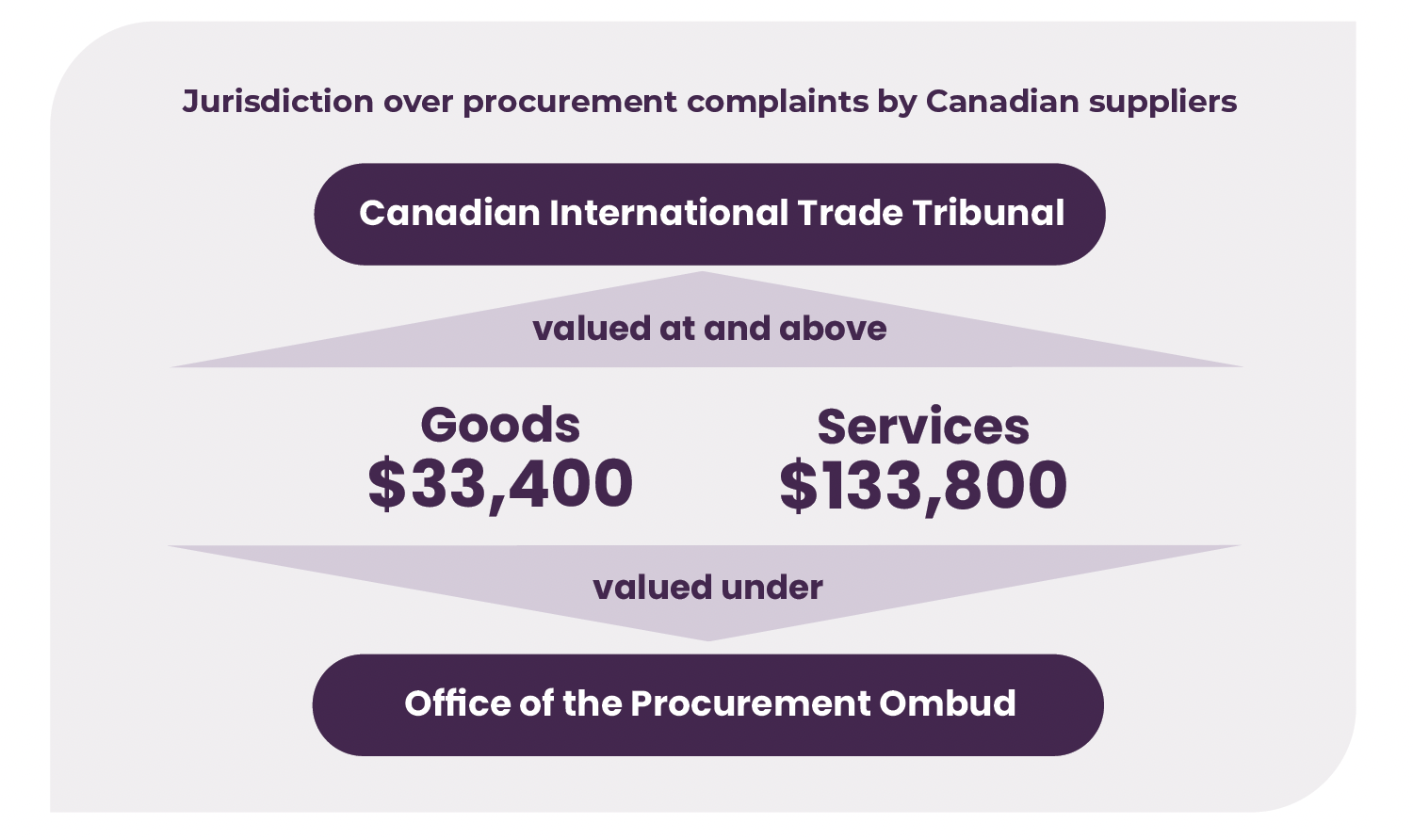
Since October 1, 2020, the Office of the Procurement Ombud (OPO) and the Tribunal have worked under a Memorandum of Understanding (MOU). The MOU aims to ease potential suppliers’ access to the complaint review system administered by both organizations. It also provides for continued cooperation between OPO and the Tribunal. The Tribunal and OPO have concurrent jurisdiction over procurement complaints brought by Canadian suppliers as follows:
Details
Monetary thresholds over procurement complaints by Canadian suppliers.
The Tribunal has jurisdiction over procurement complaints for goods valued at $33,400 and above and OPO has jurisdiction for goods valued under $33,400.
The Tribunal has jurisdiction over procurement complaints for services valued at $133,800 and above and OPO has jurisdiction for services valued under $133,800.
| Canadian International Trade Tribunal | Office of the Procurement Ombud |
| Goods valued at $33,400 and above | Goods valued under $33,400 |
| Services valued at $133,800 and above | Services valued under $133,800 |
The Tribunal has exclusive jurisdiction over complaints by foreign suppliers about government procurement processes under applicable trade agreements. When filing a complaint with either OPO or the Tribunal, complainants are given the option to share their contact information and the basic nature of their complaint with the other organization. This exchange enhances access to justice by ensuring that complainants are filing their complaints in the right place and, most importantly, in the timeliest manner possible. During this fiscal year, a majority of complainants used this service.
Officials from OPO and the Tribunal and its secretariat have continued to meet in 2023-24 to discuss each organization’s jurisdiction and how to ensure that parties have better access to justice.
Historical trend: Procurement complaints received
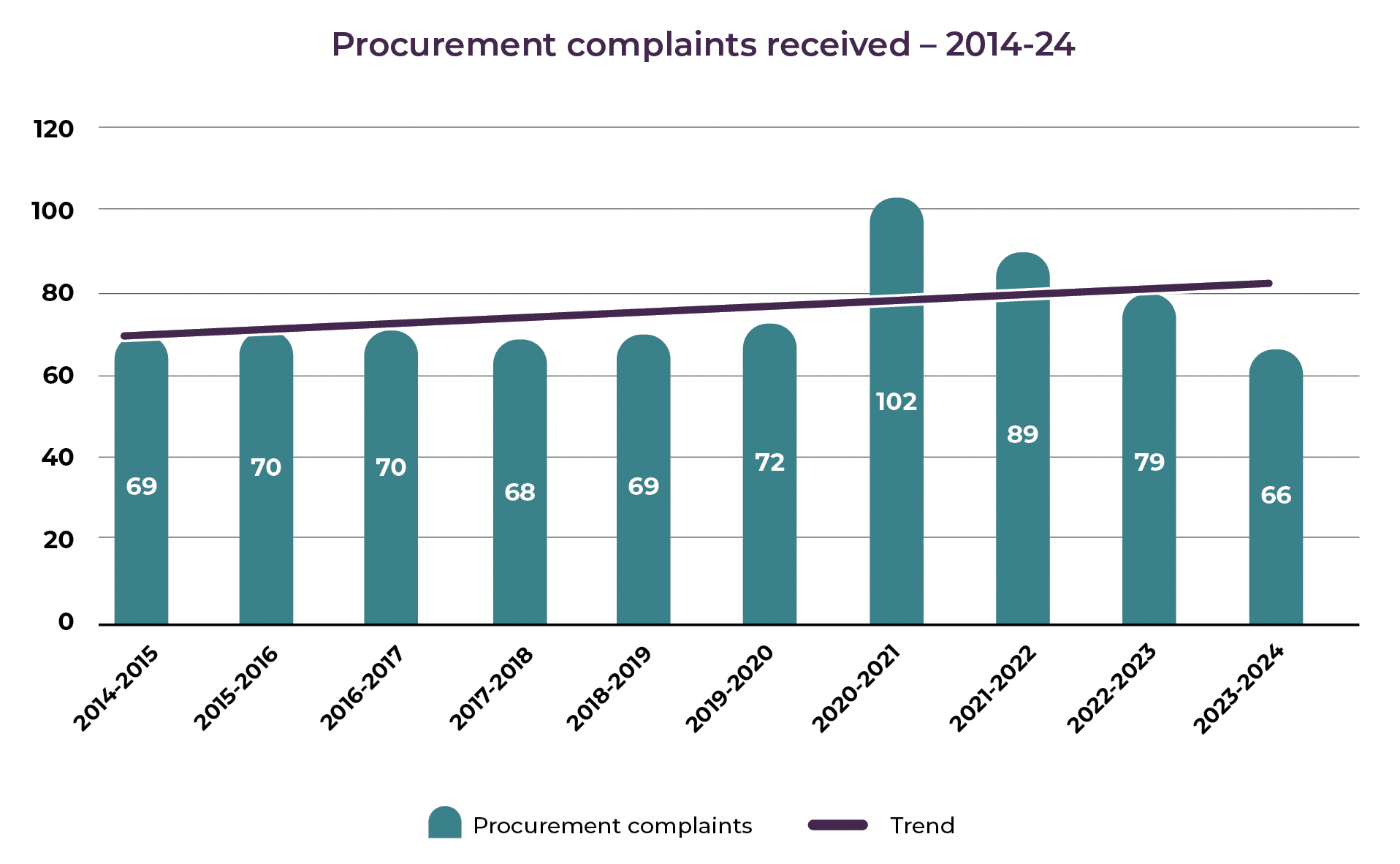
The Tribunal’s caseload for its procurement review mandate remains relatively consistent with historical trends for the last ten years.
Details
Bar chart of procurement complaints received from 2014 to 2024 and trend.
- 2014-2015: 69
- 2015-2016: 70
- 2016-2017: 70
- 2017-2018: 68
- 2018-2019: 69
- 2019-2020: 72
- 2020-2021: 102
- 2021-2022: 89
- 2022-2023: 79
- 2023-2024: 66
Procurement review activities in 2023-24
| Carried over from previous fiscal year | 6 |
|---|---|
| Received during this fiscal year | 66 |
| Total | 72 |
| Disposed during this fiscal year | 65 |
| Outstanding at the end of fiscal year | 7 |
| Total decisions issued | 38 |
|---|---|
| Of which: | |
|
Premature/late filing |
9 |
|
Lack of jurisdiction/not a potential supplier/not a designated contract |
11 |
|
No reasonable indication of a breach |
18 |
| Withdrawn/abandoned | 5 |
| Total decisions issued | 22 |
|---|---|
| Of which: | |
|
Ceased |
10 |
|
Not valid/dismissed |
7 |
|
Valid or valid in part |
5 |
Complaints received – self-represented parties
Of note, this year saw a continuation in a growing trend experienced by the Tribunal. Of the 66 complaints received this year, 51 were filed by self-represented parties. In that regard, to support such parties, the Tribunal’s website includes a set of guidelines describing the Tribunal’s procurement inquiry mandate and procedures. Potential complainants will also find on the Tribunal’s website a procurement complaint form, in multiple formats, with a comprehensive set of instructions that they can rely on to present their case to the Tribunal.
Compensation
Where the Tribunal determines that a procurement complaint is valid, it may recommend any remedy that it considers appropriate, including payment of compensation to the complainant. In cases where the Tribunal does not specify the amount of compensation to be paid, the Tribunal instructs the complainant and the government institution to negotiate that amount.
When the parties are unable to reach an agreement, the Tribunal receives submissions from the parties and establishes the final amount of compensation to be paid. The Tribunal issued one recommendation regarding compensation during this fiscal year in PricewaterhouseCoopers LLP v. Immigration and Refugee Board of Canada (PR-2020-035).
| Carried over from previous fiscal year | 2 |
|---|---|
| Initiated during this fiscal year | 2 |
| Total | 4 |
| Recommendation issued during this fiscal year | 1 |
| Ongoing at the end of fiscal year | 3 |
Sample of noteworthy decisions under the procurement review mandate
Peer Ledger Inc. (PR-2023-011)
The Royal Canadian Mint sought to procure a product for use in tracking the origin and transactional history of various gold products, including bullion. The system would enable the Mint to demonstrate that gold refined by the Mint is responsibly sourced. Peer Ledger submitted a bid in response to the Mint’s tender but was not awarded a contract. Peer Ledger filed a complaint with the Tribunal claiming that the Mint did not fairly evaluate Peer Ledger’s bid.
Having regard to the terms of the Canadian International Trade Tribunal Act and the Canadian Free Trade Agreement (CFTA), the Tribunal’s jurisdiction is limited to the procurement of goods and services for “governmental purposes”. In addressing the characteristics of a procurement for “governmental purposes”, the CFTA operates to exclude goods and services procured for commercial sale or resale, or for use in the production or supply of a good or service for commercial sale or resale. The Mint asserted that it was procuring the software for the commercial aspect of its activities and not for a “governmental purpose”.
The Tribunal reviewed the Mint’s enabling statute, the Royal Canadian Mint Act (RCM Act), to determine the scope of the Mint’s objectives and purpose. The Tribunal found that the procurement was for a “governmental purpose” because the Mint was procuring goods and services to carry out activities specifically authorized by Parliament in the RCM Act, including the melting, assay and refining of gold, silver and other metals and the secure storage and shipment of coins, gold, silver and other metals. However, the RCM Act also authorizes the Mint to engage in commercial activities for profit. In this case, it was procuring the software to form part of the Mint’s commercial product offering to third parties and was intended to be associated with the bullion products sold by the Mint for its own profit.
The Tribunal concluded that, although the procurement was for a “governmental purpose”, it fell within the scope of the exclusion for commercial sale or resale define by article 504(2)(b) of the CFTA. Accordingly, the Tribunal found that it lacked jurisdiction and ceased its inquiry.
Pomerleau Inc. (PR-2022-073) and EllisDon Corporation (PR-2023-010)
Public Services and Procurement Canada (PSPC) mishandled an electronic bid bond (e-bond), which led to two separate complaints brought before the Tribunal. The complaints were about an invitation to tender (ITT) that PSPC issued to improve a building in Charlottetown, Prince Edward Island. EllisDon and Pomerleau submitted bids in response to the ITT with the required e-bonds.
A PSPC employee accidentally changed Pomerleau’s e-bond, which invalidated its data. PSPC therefore could not verify the e-bond and disqualified Pomerleau’s bid. PSPC awarded the contract to EllisDon. Pomerleau objected immediately and informed PSPC of the error. PSPC did not acknowledge the error, even though it had all necessary information at its disposal to determine that it had made a mistake. Pomerleau then filed a complaint with the Tribunal.
After the Tribunal decided to look into Pomerleau’s complaint, and 10 weeks after Pomerleau’s initial objection to PSPC, Pomerleau told the Tribunal that it had reached an agreement with PSPC. Because PSPC would award Pomerleau the contract, it withdrew its complaint. PSPC cancelled its contract with EllisDon.
EllisDon then filed a complaint with the Tribunal, arguing that PSPC did not properly evaluate Pomerleau’s bid and that it took too long to correct its error. EllisDon claims that this caused it harm.
The Tribunal found that PSPC breached the trade agreements by not properly evaluating the bids. The Tribunal also found that PSPC mishandled Pomerleau’s e-bond, wrongly awarded the contract to EllisDon and negligently provided false information to potential suppliers. It also took months to fix the original error. As a remedy, the Tribunal recommended that PSPC compensate EllisDon for damages for lost opportunity, if any. PSPC has appealed the Tribunal’s decision to the Federal Court of Appeal.
Chantier Davie Canada Inc. and Wärtsilä Canada Inc. (PR-2023-006)
The Tribunal looked into a complaint that Chantier Davie Canada Inc. and Wärtsilä Canada Inc. filed about a procurement that PSPC conducted for the Department of Fisheries and Oceans (DFO). The DFO required certain work to be done on the Canadian Coast Guard ship Terry Fox, including the replacement of engines.
Chantier Davie and Wärtsilä claimed that PSPC improperly kept a contract that it had awarded to Heddle Marine Service Inc. even after the Tribunal had recommended a re-evaluation of bids as a remedy in PR-2022-053, a previous case. The Tribunal found that the complaint was valid in part because PSPC chose to keep the contract it had awarded to Heddle despite strong evidence demonstrating that its bid did not meet a mandatory requirement. As a result, the Tribunal recommended that PSPC compensate Chantier Davie and Wärtsilä for the potential profit they lost.
Chantier Davie and Wärtsilä also claimed that PSPC did not fulfill its debriefing obligations, which required that it explain to them why they did not win the contract. While the Tribunal did not need to decide on that issue, it still commented on the need for transparency in the context of debriefing obligations. The Tribunal noted that the Canadian Free Trade Agreement requires that government institutions conduct procurement processes openly and transparently. Considering this requirement, the Tribunal invited PSPC to review how it can meet those obligations in a better way through meaningful debriefings to losing bidders.